In plain English
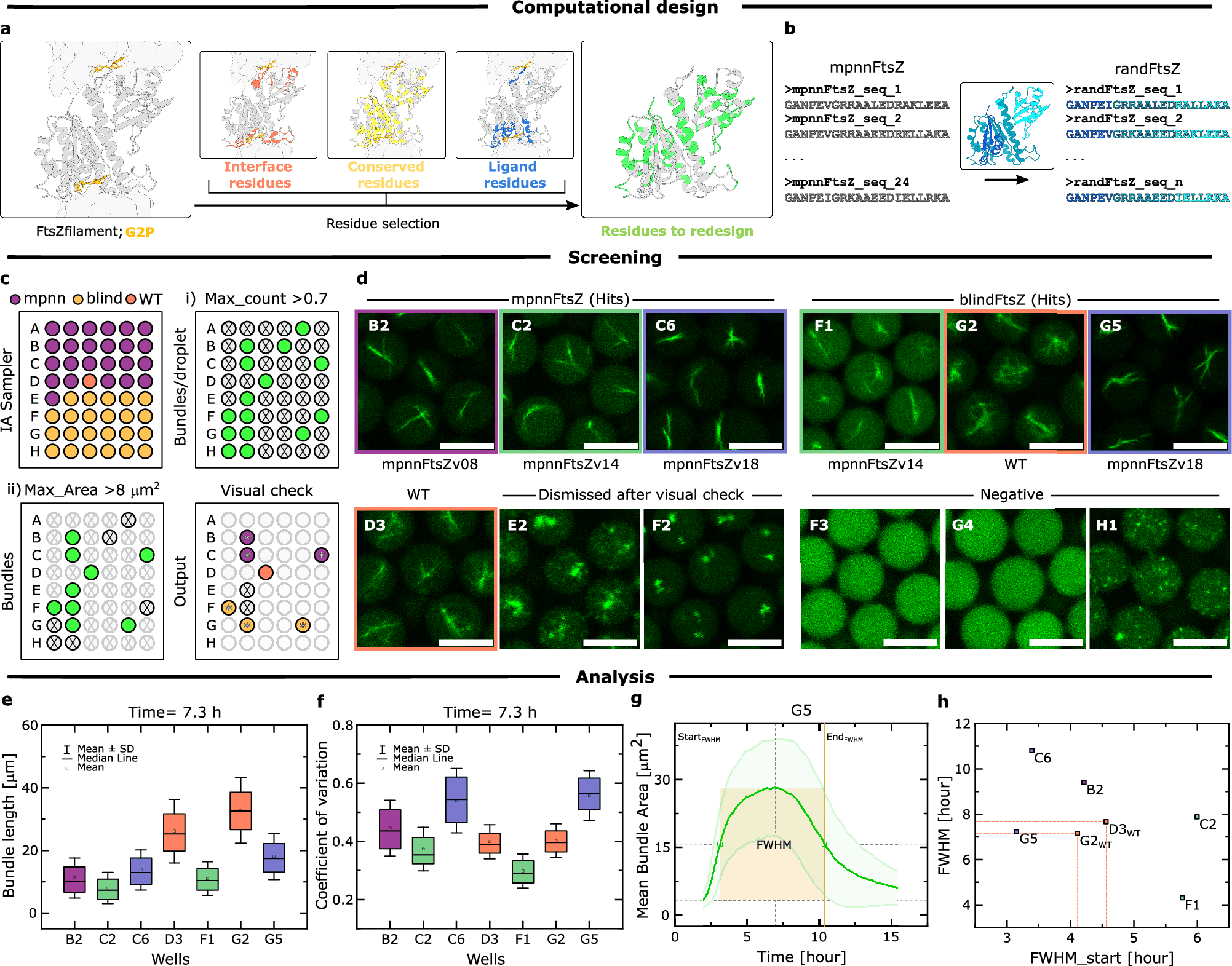
The platform loads different protein constructs from a plate, expresses each one in thousands of tiny cell-like droplets, and follows their behavior by time-lapse imaging. In proof-of-principle screens, the team found redesigned FtsZ variants with altered assembly behavior and a combination of modulators that anchored FtsZ filaments at the droplet interface in a ring-like pattern.
How the study worked
A plain-language walk through the work behind the result.
Built an automated microfluidic workflow that expresses protein libraries in picoliter synthetic cells organized in a 96-well plate.
Screened computationally redesigned FtsZ variants and then a panel of proteins that modulate FtsZ assembly.
What they found
- The screen distinguished variants with altered FtsZ bundling phenotypes and expression kinetics.
- A tested modulator combination anchored filaments to the interface and produced a ring-like phenotype.
Why it matters
The system adds spatial and temporal readouts to experimental protein-design loops that are often limited to bulk endpoint measurements.
The catch
- The demonstrations center on FtsZ behavior in a cell-free synthetic-cell system.
- The abstract does not establish performance across broad protein families or larger design libraries.
- Synthetic droplets do not reproduce the full complexity of living cells.