In plain English
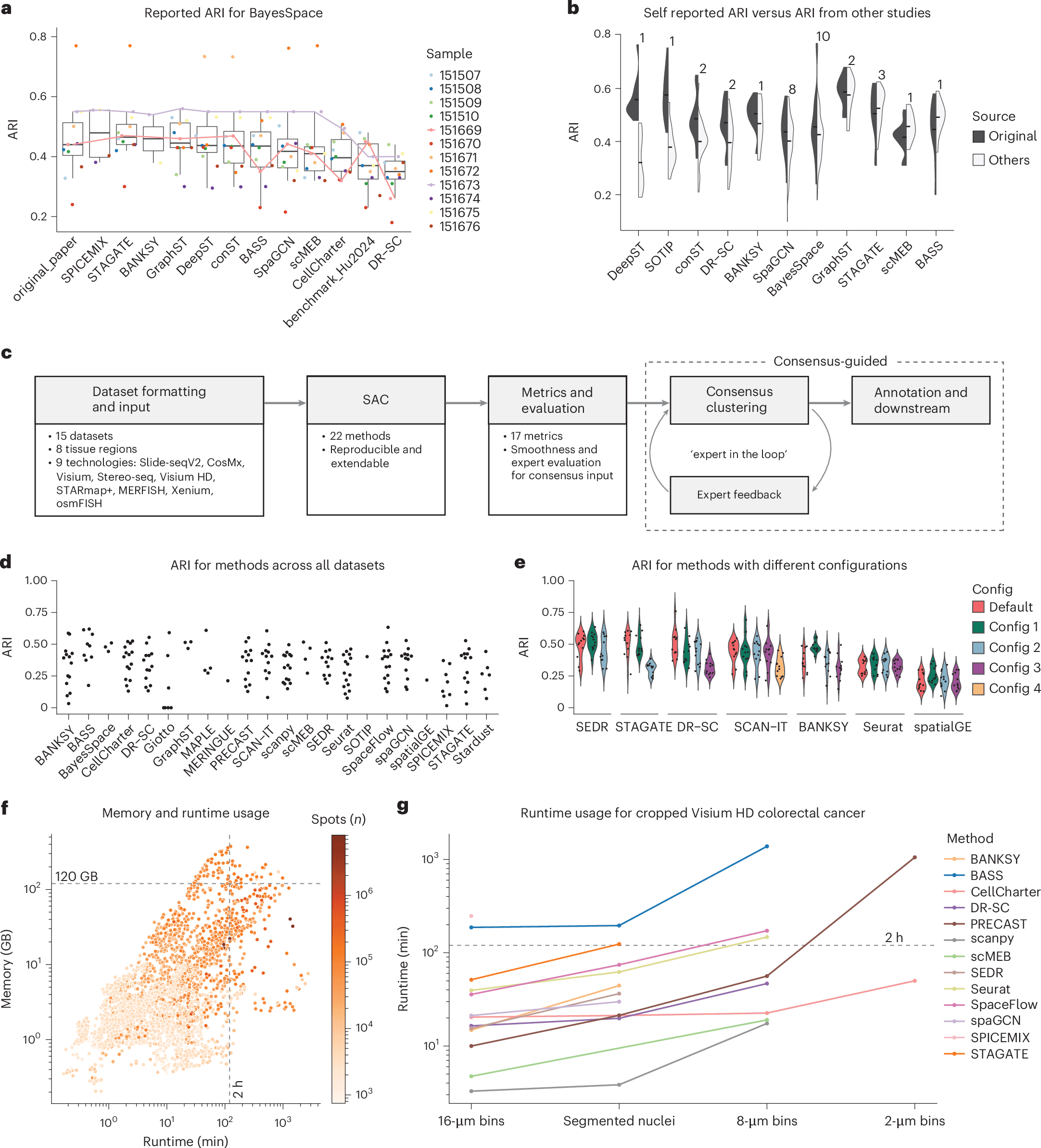
Spatial-transcriptomics tools divide tissue into regions, but the usual 'ground truth' labels can be incomplete or misleading. The collaboration compared many clustering outputs, built consensus groupings, mapped where methods disagreed, and brought histology and cell-biology expertise into the evaluation loop.
How the study worked
A plain-language walk through the work behind the result.
Compared spatially aware clustering methods and configurations across benchmark datasets.
Built consensus clusterings and used expert feedback to inspect disagreements with reference annotations.
What they found
- Methods could agree with one another more strongly than with the supplied reference labels.
- Consensus and entropy maps highlighted uncertain tissue boundaries and helped focus expert review.
Why it matters
Benchmark design can change which computational method looks best; making uncertainty and expert interpretation explicit should reduce false confidence in spatial-biology pipelines.
The catch
- Consensus is not a substitute for biological ground truth.
- Expert-guided evaluation can improve relevance but introduces time and domain-specific judgment.