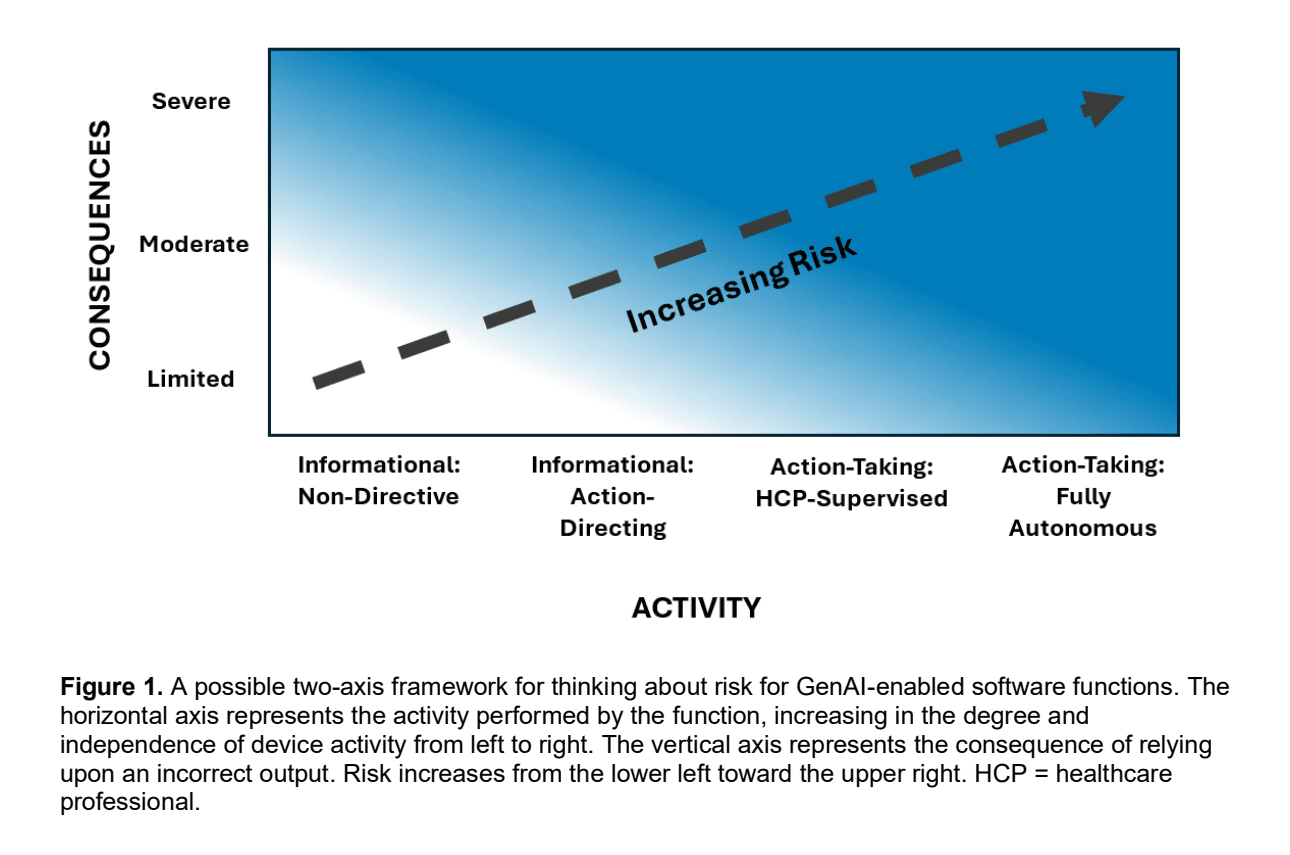
FDA issued a discussion paper on medical software that uses generative AI. It sketches possible approaches to risk assessment, testing before launch, and monitoring afterward. It is a request for feedback, not draft or final guidance and not a policy change.
What happened
- FDA's Digital Health Center of Excellence opened a public discussion on how to oversee medical software that generates content or actions.
- The paper considers a two-axis risk heuristic, premarket benchmarking plus clinical confirmation, and risk-proportionate postmarket monitoring.
Why it matters
The paper identifies the questions that may shape future evidence expectations for adaptive, foundation-model-based, and agentic medical software.
Key details
- Document status
- Discussion paper; not draft or final guidance
- Scope
- Risk assessment, premarket evaluation, postmarket monitoring, foundation models, and agentic systems
What to watch
- Whether public feedback produces a more formal proposal with testable regulatory expectations.
Event chronology
How the story developed
Discussion paper issued
FDA published the paper and opened a request for stakeholder feedback.
Evidence ledger
Sources behind this brief
- 01Primary source
FDA discussion paper and request for feedback
primary source · Accessed August 24, 2026