Bhattacharya, A. and colleagues report that a data-fusion model projected cortical Alzheimer's signatures across a 108-region whole-brain single-cell atlas.
Ahsan and colleagues trained a contrastive learning model on spatial transcriptomics and tissue images to predict pathway-level expression from routine histology.
Xi, G. reports that scDisent separates expression-linked and regulation-linked variables instead of compressing multi-omic measurements into one latent space.
Li, L. and colleagues found that high expression similarity often failed to preserve the drug-response signatures models were meant to predict using a mechanism-aware benchmark.
Sallam, A. and colleagues report that an unsupervised stress test separated single-cell foundation models that looked nearly equivalent on standard downstream benchmarks.
Kate E. Cavanaugh and colleagues report that older mouse embryos were more contractile and viscous, which impaired spreading during implantation; related imaging signatures also tracked human embryo potential.
Xin Gao and colleagues report that yeast cells grew faster by increasing mRNA and ribosome concentrations together, raising the number of active ribosomes without speeding elongation.
Yan Peng and colleagues report that dREAMS maps multiple DNA and RNA modifications across tissue and linked TET1 loss to altered RNA m1A patterns in mouse brain.
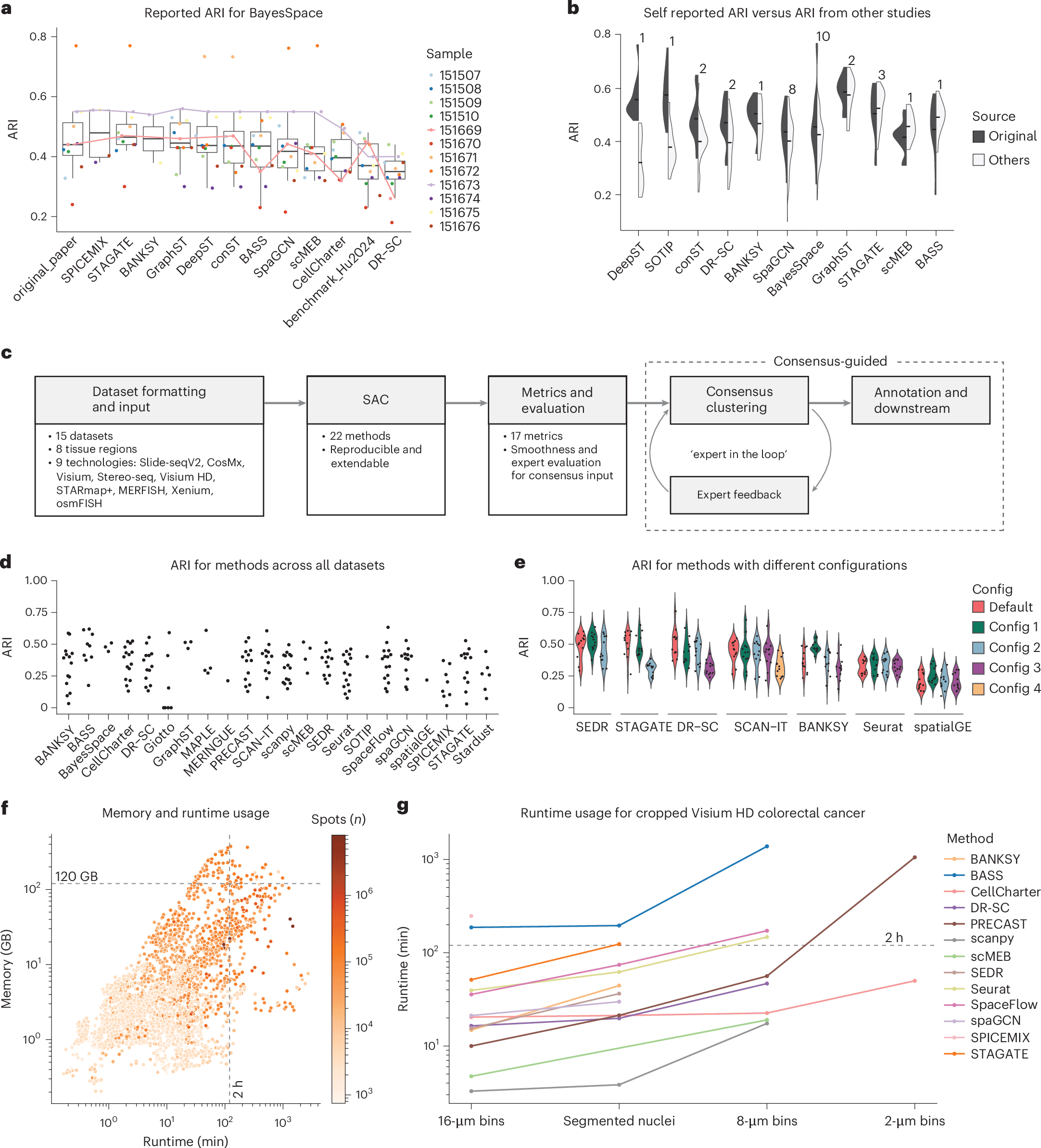
Jieran Sun and colleagues report that sACCELERATOR combines agreement among algorithms with expert tissue knowledge to make spatial-clustering benchmarks more biologically useful.
Yuheng Zhu and colleagues report that pSTN links single-cell and spatial transcriptomics across infection time points instead of integrating each stage separately.
Jiedan Xiao and colleagues report that a conditional diffusion model reconstructs plausible single-cell populations from bulk-like expression summaries.
Yuyan Chen reports that a DNA foundation model combines sequence with local and global chromatin accessibility while trying to prevent one modality from overwhelming the representation.
Maximilien Burq and colleagues matched or beat much larger RNA-only models on most reported benchmarks using a small biological foundation model trained with proteomics.
Hanchen Wang and colleagues report that perturb-ME combines phenotype enrichment, genome-scale CRISPR, and multimodal single-cell readouts to map mechanisms behind a selected phenotype.
Yue You and colleagues report that a preprint combines an immune-aging score, a tokenized virtual-cell model, and an agent that revises its own compound-scoring objective.